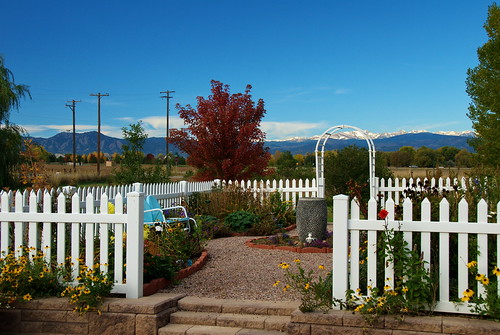
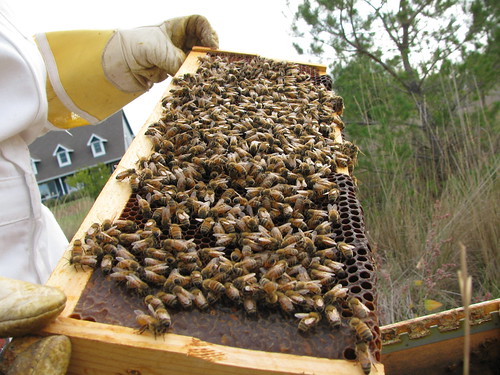
Another early snowstorm in the bee-yard.
Sunday, November 15, 2009
Tuesday, November 10, 2009
2009 Harvest Summary
Another growing season gone and Thanksgiving is fast approaching, that means its time to review the year's harvest totals and give thanks for the blessings from our garden. As of Nov 10, most of the 2008 harvest is in(we still have a few carrots remaining). We had some challenges this year with the weather and the bees but we still got plenty to be thankful for.
We didn’t set any new records this year for production but we were above the average yield in several categories. A hail storm ravaged our garden on July 28th destroying a lot of the produce. Despite the damage we were still above average on our garlic, green beans and snow peas. We also added laying hens for fresh eggs this year. We have five layers that are produced as much as 30 eggs per week before the winter set in.
2009 harvest totals:
• Carrots 21.7 lbs (so far), 56% of average yield
• Cucumbers 26.3 lbs, 94% of average yield
• Eggs 25.6 dozen (new category)
• Garlic 5.2 lbs, 128% of average yield
• Green Beans 23.3 lbs, 139% of average yield
• Honey 107.5 lbs, 86% of average yield
• Beeswax 2 lbs
• Lettuce & Salad Greens 5.2 lbs, 86% of average yield
• Onions 1.5 lbs (volunteers)
• Peppers 23.8 lbs, 46% of average yield
• Rhubarb 5.4 lbs, 49% of average yield
• Snow Peas 8.8 lbs, 194% of average yield
• All Squash 83.4 lbs, 52% of average yield
• Tomatoes 172.9 lbs, 98% of average yield
2009 Climate Summary:
This summer's growing season was longer than normal and had an early start. This should have set us up for great harvests, but the hail came. We had our last frost of spring on April 19th and our first frost of the fall on October 2nd giving us a growing season of 166 days this year. We had good consistent rains from April through July this year, which was above average, but 64 days were rainy, which may have kept the bees inside more than normal at least partially accounting for our lower honey production. Our total summer rainfall was above normal with 9.8" from April through October with August being our driest month with only 0.12” for the month. September was also dry, so the late-summer required a lot of extra watering again this year.
It was also a cool summer with average temps peaking at only 69°F in July, and once again with no days above 100 degrees. The maximum temp for the entire summer was only 96°F on July 24th.
We didn’t set any new records this year for production but we were above the average yield in several categories. A hail storm ravaged our garden on July 28th destroying a lot of the produce. Despite the damage we were still above average on our garlic, green beans and snow peas. We also added laying hens for fresh eggs this year. We have five layers that are produced as much as 30 eggs per week before the winter set in.
2009 harvest totals:
• Carrots 21.7 lbs (so far), 56% of average yield
• Cucumbers 26.3 lbs, 94% of average yield
• Eggs 25.6 dozen (new category)
• Garlic 5.2 lbs, 128% of average yield
• Green Beans 23.3 lbs, 139% of average yield
• Honey 107.5 lbs, 86% of average yield
• Beeswax 2 lbs
• Lettuce & Salad Greens 5.2 lbs, 86% of average yield
• Onions 1.5 lbs (volunteers)
• Peppers 23.8 lbs, 46% of average yield
• Rhubarb 5.4 lbs, 49% of average yield
• Snow Peas 8.8 lbs, 194% of average yield
• All Squash 83.4 lbs, 52% of average yield
• Tomatoes 172.9 lbs, 98% of average yield
2009 Climate Summary:
This summer's growing season was longer than normal and had an early start. This should have set us up for great harvests, but the hail came. We had our last frost of spring on April 19th and our first frost of the fall on October 2nd giving us a growing season of 166 days this year. We had good consistent rains from April through July this year, which was above average, but 64 days were rainy, which may have kept the bees inside more than normal at least partially accounting for our lower honey production. Our total summer rainfall was above normal with 9.8" from April through October with August being our driest month with only 0.12” for the month. September was also dry, so the late-summer required a lot of extra watering again this year.
It was also a cool summer with average temps peaking at only 69°F in July, and once again with no days above 100 degrees. The maximum temp for the entire summer was only 96°F on July 24th.
Sunday, October 18, 2009
Fall Beehive Inspections
We had a wonderful weekend with highs in the 70s and low 80s and light winds. It was ideal to do an inspection of our beehives to see if they are ready for winter. It was mostly bad news again.

This is one of the center frames from the upper box of Hive #1 (survivor colony). They have a bit more honey in the edges of the box, but they are in bad shape regarding reserves and will starve without more honey.

This is brood chamber (lower) from Hive #1. As you can see there is nearly no brood and we saw no larvae and no eggs. This looks like a death sentence for this colony. We put on a pollen patty and will start feeding winter syrup, but it may be too late.

This frame is from the upper box of Hive #2 (feral colony). They seem to have one box full of honey, with a bit more in the middle box. We harvested nothing from this colony this year.

This frame is from the middle box of Hive #2. There was some capped brood, but we saw almost no larvae or eggs.

This frame is the honey stores from the upper chamber of Hive #3 (2009 package colony).

This frame is from the center brood chamber of hive #3. Where is the brood?

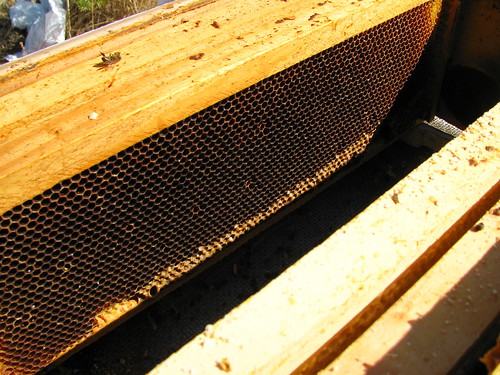
Lower level frame from hive #3. No brood, no pollen, no honey.
We put pollen patties on all three hives to try to encourage some new brood, but it looks like it's going to be a tough winter for our bees.

This is one of the center frames from the upper box of Hive #1 (survivor colony). They have a bit more honey in the edges of the box, but they are in bad shape regarding reserves and will starve without more honey.

This is brood chamber (lower) from Hive #1. As you can see there is nearly no brood and we saw no larvae and no eggs. This looks like a death sentence for this colony. We put on a pollen patty and will start feeding winter syrup, but it may be too late.

This frame is from the upper box of Hive #2 (feral colony). They seem to have one box full of honey, with a bit more in the middle box. We harvested nothing from this colony this year.

This frame is from the middle box of Hive #2. There was some capped brood, but we saw almost no larvae or eggs.

This frame is the honey stores from the upper chamber of Hive #3 (2009 package colony).

This frame is from the center brood chamber of hive #3. Where is the brood?

Lower level frame from hive #3. No brood, no pollen, no honey.
We put pollen patties on all three hives to try to encourage some new brood, but it looks like it's going to be a tough winter for our bees.
Monday, September 21, 2009
Honey Harvest 2009

Well it has been a tough year for the bees. Our bees only produced 1/3 of what they did last year. The total production this year was just over 100 lbs, making this liquid gold even more precious this year.
We're really not sure what happened though. The newbees we purchased in April that gave us fits with the failed queen release have been nothing but trouble this year. They were supposed to be Minnesota Hygienic bees, but I'm not so sure. They don't behave at all like those we've had before. The queen must be a party animal, she is very productive and the colony built up very fast and very strong. This new colony is also the most aggressive bees we've ever had - they are HOT! The last few times we've been out to visit the hives, just as soon as we take the lid of of these hundreds come pouring out and go straight for your face with aggression. It wouldn't be so bad if that is what we were accustomed to, but the other colonies are gentle lady-bugs by comparison.
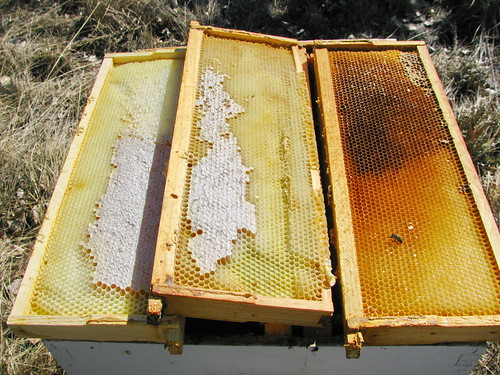
The other thing strange about this colony was the unusual open patterns in the honey frames as shown in the photo in the previous post. Even at harvest, we found nearly all of the frames half-empty, and dotted with pollen as shown below - very strange. This really reduced our harvest. It was not as if they had been raided or even got hungry, rather the open parts were never touched. I'm putting blame on bad genetics and we'll replace the queen.
The survivor colony was slow building up in the spring and slow to fill the honey supers too. There was nothing particularly unusual about them this year, no ailments, just generally not very strong. Looks like another candidate for queen replacement, should they actually survive the winder again.
Finally we have the feral colony we rescued from a tree. They seem strong enough, but not too aggressive. But we got them so late they didn't really have any opportunity to compete for production this year. They now seem to have a good population and hopefully they'll survive the winter and be our most productive colony next year. We'll see. Maybe they will produce another queen we can use on one of the other colonies too.
Saturday, July 25, 2009
Honey progress
Well it is late July and we have a total of 5 honey supers now installed on the three colonies. We installed the first one today on the new colony we captured as a swarm in June. We did an inspection of the others today and there was some mixed news.
The survivor colony was doing well and got its second super just one week ago. Today they have done a good job of filling most of it with nectar, but nothing capped yet. The patters look typical (see the photo below):

Now we moved down to the new colony of Minnesota Hygienics we started from a package in April. We noticed something strange as we pulled a few frames out for inspection. One edge was completely capped and the other edge had untouched comb, with some spotty places where there seemed to be pollen being stored. (This hive has a queen excluder installed.) Here is a picture of the pattern:

Here is a close-up of some of the pollen on that same frame:

So what is going on with this colony and the honey?
The survivor colony was doing well and got its second super just one week ago. Today they have done a good job of filling most of it with nectar, but nothing capped yet. The patters look typical (see the photo below):

Now we moved down to the new colony of Minnesota Hygienics we started from a package in April. We noticed something strange as we pulled a few frames out for inspection. One edge was completely capped and the other edge had untouched comb, with some spotty places where there seemed to be pollen being stored. (This hive has a queen excluder installed.) Here is a picture of the pattern:

Here is a close-up of some of the pollen on that same frame:

So what is going on with this colony and the honey?
Thursday, July 02, 2009
First Eggs!

July 2nd, 2009: Our chicks are nearly 16 weeks old and we got our first eggs today. One little egg and a medium sized one. We're not sure which hens were responsible but based on their maturity, probably Beau and/or Ankita.
Tuesday, June 23, 2009
June Update
With all the rain we've had this spring, the wildflowers are going crazy this year, but the bees are not. Perhaps it's been too wet for them or just too cool, but they have not built up very fast nor filled the added space we gave them a few weeks ago and have done little or nothing with the honey supers we put on. The one survivor colony is building up rather slowly and the brood patterns have not been very good. The queen is showing her age.
The new colony has built up faster and seems to have a good queen, but they are still a new colony and haven't done much with the honey yet.
On this past Sunday, we found this swarm in one of our trees:

Fortunately for us, it was not very high so it was easy to remove and capture. We're pretty sure it was not from one of our hives since they have been struggling. We scrounged some spare parts and kludged a new hive together to put them into. We learned the lesson from the last swarm capture that escaped and we taped up the entrance hole for 2 days before letting them out. So far they seem to be settling into their new home. So hopefully they won't leave and we'll have some "freebees"!
The new colony has built up faster and seems to have a good queen, but they are still a new colony and haven't done much with the honey yet.
On this past Sunday, we found this swarm in one of our trees:

Fortunately for us, it was not very high so it was easy to remove and capture. We're pretty sure it was not from one of our hives since they have been struggling. We scrounged some spare parts and kludged a new hive together to put them into. We learned the lesson from the last swarm capture that escaped and we taped up the entrance hole for 2 days before letting them out. So far they seem to be settling into their new home. So hopefully they won't leave and we'll have some "freebees"!
Subscribe to:
Posts (Atom)