Sunday, October 18, 2009

Fall Beehive Inspections

We had a wonderful weekend with highs in the 70s and low 80s and light winds. It was ideal to do an inspection of our beehives to see if they are ready for winter. It was mostly bad news again.
IMG_7164
This is one of the center frames from the upper box of Hive #1 (survivor colony). They have a bit more honey in the edges of the box, but they are in bad shape regarding reserves and will starve without more honey.

IMG_7168
This is brood chamber (lower) from Hive #1. As you can see there is nearly no brood and we saw no larvae and no eggs. This looks like a death sentence for this colony. We put on a pollen patty and will start feeding winter syrup, but it may be too late.

IMG_7172
This frame is from the upper box of Hive #2 (feral colony). They seem to have one box full of honey, with a bit more in the middle box. We harvested nothing from this colony this year.

IMG_7173
This frame is from the middle box of Hive #2. There was some capped brood, but we saw almost no larvae or eggs.

IMG_7178
This frame is the honey stores from the upper chamber of Hive #3 (2009 package colony).

IMG_7180
This frame is from the center brood chamber of hive #3. Where is the brood?

IMG_7181
Lower level frame from hive #3. No brood, no pollen, no honey.

We put pollen patties on all three hives to try to encourage some new brood, but it looks like it's going to be a tough winter for our bees.

Monday, September 21, 2009

Honey Harvest 2009


Well it has been a tough year for the bees. Our bees only produced 1/3 of what they did last year. The total production this year was just over 100 lbs, making this liquid gold even more precious this year.

We're really not sure what happened though. The newbees we purchased in April that gave us fits with the failed queen release have been nothing but trouble this year. They were supposed to be Minnesota Hygienic bees, but I'm not so sure. They don't behave at all like those we've had before. The queen must be a party animal, she is very productive and the colony built up very fast and very strong. This new colony is also the most aggressive bees we've ever had - they are HOT! The last few times we've been out to visit the hives, just as soon as we take the lid of of these hundreds come pouring out and go straight for your face with aggression. It wouldn't be so bad if that is what we were accustomed to, but the other colonies are gentle lady-bugs by comparison.

The other thing strange about this colony was the unusual open patterns in the honey frames as shown in the photo in the previous post. Even at harvest, we found nearly all of the frames half-empty, and dotted with pollen as shown below - very strange. This really reduced our harvest. It was not as if they had been raided or even got hungry, rather the open parts were never touched. I'm putting blame on bad genetics and we'll replace the queen.

The survivor colony was slow building up in the spring and slow to fill the honey supers too. There was nothing particularly unusual about them this year, no ailments, just generally not very strong. Looks like another candidate for queen replacement, should they actually survive the winder again.

Finally we have the feral colony we rescued from a tree. They seem strong enough, but not too aggressive. But we got them so late they didn't really have any opportunity to compete for production this year. They now seem to have a good population and hopefully they'll survive the winter and be our most productive colony next year. We'll see. Maybe they will produce another queen we can use on one of the other colonies too.

Saturday, July 25, 2009

Honey progress

Well it is late July and we have a total of 5 honey supers now installed on the three colonies. We installed the first one today on the new colony we captured as a swarm in June. We did an inspection of the others today and there was some mixed news.
The survivor colony was doing well and got its second super just one week ago. Today they have done a good job of filling most of it with nectar, but nothing capped yet. The patters look typical (see the photo below):
IMG_6919

Now we moved down to the new colony of Minnesota Hygienics we started from a package in April. We noticed something strange as we pulled a few frames out for inspection. One edge was completely capped and the other edge had untouched comb, with some spotty places where there seemed to be pollen being stored. (This hive has a queen excluder installed.) Here is a picture of the pattern:
IMG_7002

Here is a close-up of some of the pollen on that same frame:
IMG_7003

So what is going on with this colony and the honey?

Thursday, July 02, 2009

First Eggs!


July 2nd, 2009: Our chicks are nearly 16 weeks old and we got our first eggs today. One little egg and a medium sized one. We're not sure which hens were responsible but based on their maturity, probably Beau and/or Ankita.

Tuesday, June 23, 2009

June Update

With all the rain we've had this spring, the wildflowers are going crazy this year, but the bees are not. Perhaps it's been too wet for them or just too cool, but they have not built up very fast nor filled the added space we gave them a few weeks ago and have done little or nothing with the honey supers we put on. The one survivor colony is building up rather slowly and the brood patterns have not been very good. The queen is showing her age.

The new colony has built up faster and seems to have a good queen, but they are still a new colony and haven't done much with the honey yet.

On this past Sunday, we found this swarm in one of our trees:
Honeybee Swarm
Fortunately for us, it was not very high so it was easy to remove and capture. We're pretty sure it was not from one of our hives since they have been struggling. We scrounged some spare parts and kludged a new hive together to put them into. We learned the lesson from the last swarm capture that escaped and we taped up the entrance hole for 2 days before letting them out. So far they seem to be settling into their new home. So hopefully they won't leave and we'll have some "freebees"!

Monday, May 25, 2009

Spring build-up

May 16th: We did a hive inspection and found that both colonies seemed to be thriving and needed more space. Since this is peak swarming season around here, we wanted to be careful and make sure they didn't feel crowded. The spring fruit trees were also peaking a bit later than usual this year, so we also wanted to try to capture some of the nectar flow.

DNB_3474
Click here to see a 3D version of this picture (use red-cyan 3d glasses).

We added the third brood box to the new colony. On the survivor colony we installed the queen excluder and the first honey super. During the inspection of this hive I caught a brief look at the queen, which hadn't been seen in almost a year. She is still productive, but the brood patterns weren't quite as impressive as last year.

Honeybee on Cherry Blossom
Honeybee on our cherry blossoms.

Honeybee on Chokecherry blooms
Honeybee on our chokecherry blooms.

May 25th: We've had quite a bit of rain and the bees have been busy. I opened the hives up briefly to see how things were progressing. On the new colony I saw some new larvae in the recently installed frame, but no capped honey. I was hoping this hive would be ready for the first honey super, but it was not.

On the survivor colony I hoped to see some progress with the honey, but there was 0% capped and it seemed as if those bees returning to the hive were simply ignoring the new super and going straight down to the brood chamber with their loads. Perhaps it was not quite as ready as I expected.

June is just around the corner and with all the recent rain there should be a good nectar flow coming.

Saturday, May 16, 2009

Springtime Blossoms

Red Columbine
Red Columbine in our cutting garden.


First Iris of Spring
The first iris of spring.

Lilacs up close (3D)
3D Lilac blossoms (you'll need the 3D anaglyph glasses to view)

Sunday, May 03, 2009

Queen Updates

We opened up the new colony of hygienic bees today to check to see if the queen we released last week has been accepted and is productive. There was good news as she has been busy and there was some good brood now at various stages. Here is the picture:
IMG_6459
It looks like the new queen was ready and waiting and is now working hard.

On to hive #1 and last year's Minnesota Hygienic colony; they seem to have fully survived the winter and we finally found the queen today. There was some good brood pattens on some frames, but also some spotty brood patterns on others. We rotated the deep boxes this time too.

Sunday, April 26, 2009

Introducing... Chickens

We just became "chicken-keepers". Here are a few pictures introducing the new chicks at six weeks:
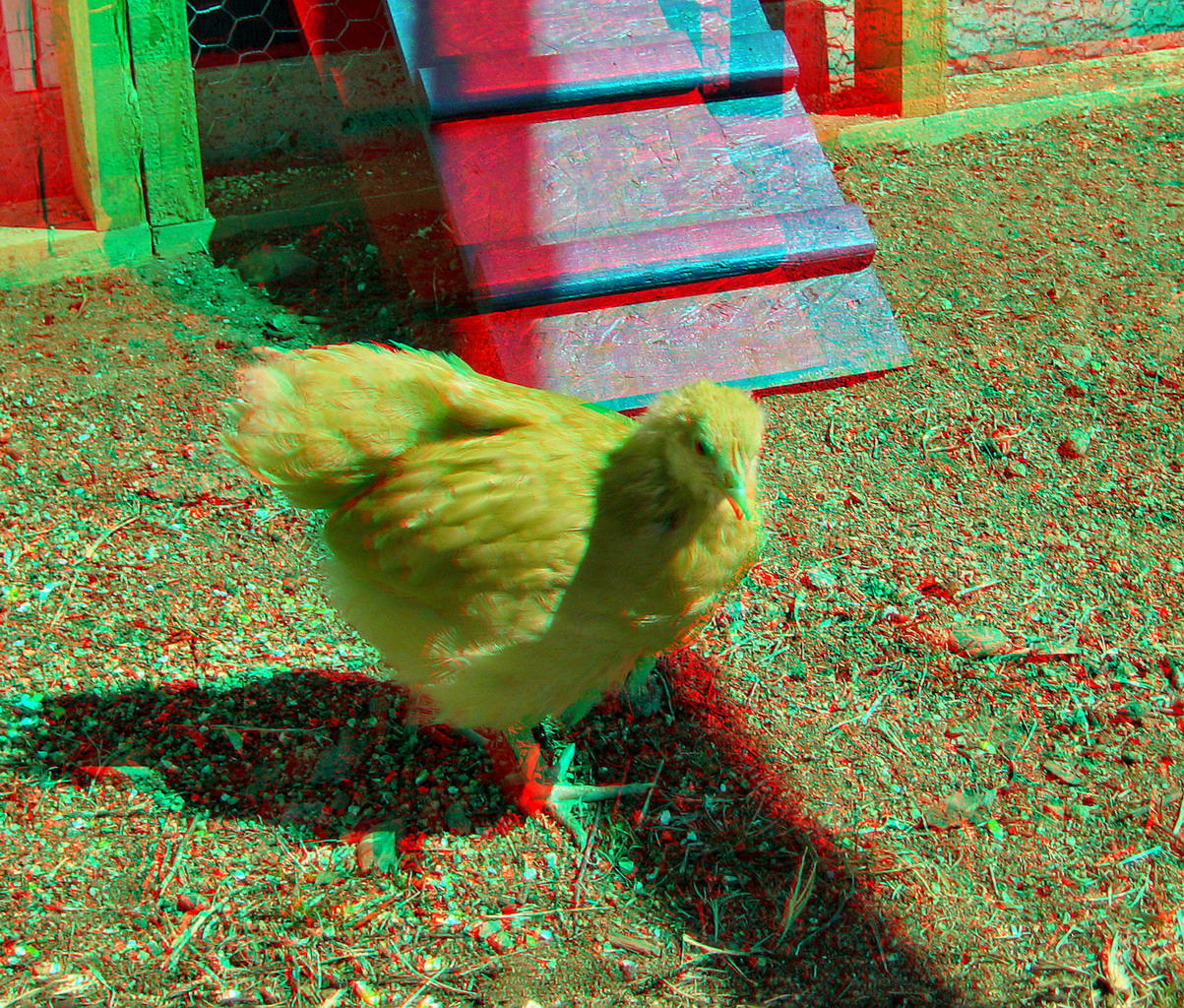
Ginger
"Ginger" is a Buff Orpington and is very friendly. She is the first one to come running to greet people. Click here to see Ginger in 3D (anaglyph 3D glasses needed)


Beau-Peep
Above is Beau-Peep. When she was a young chick, she looked just like one of those marshmallow Peeps you see around Easter. She is a Red Star and is friendly and even tempered. Click here to see the 3D image of Beau (anaglyph 3D glasses required).


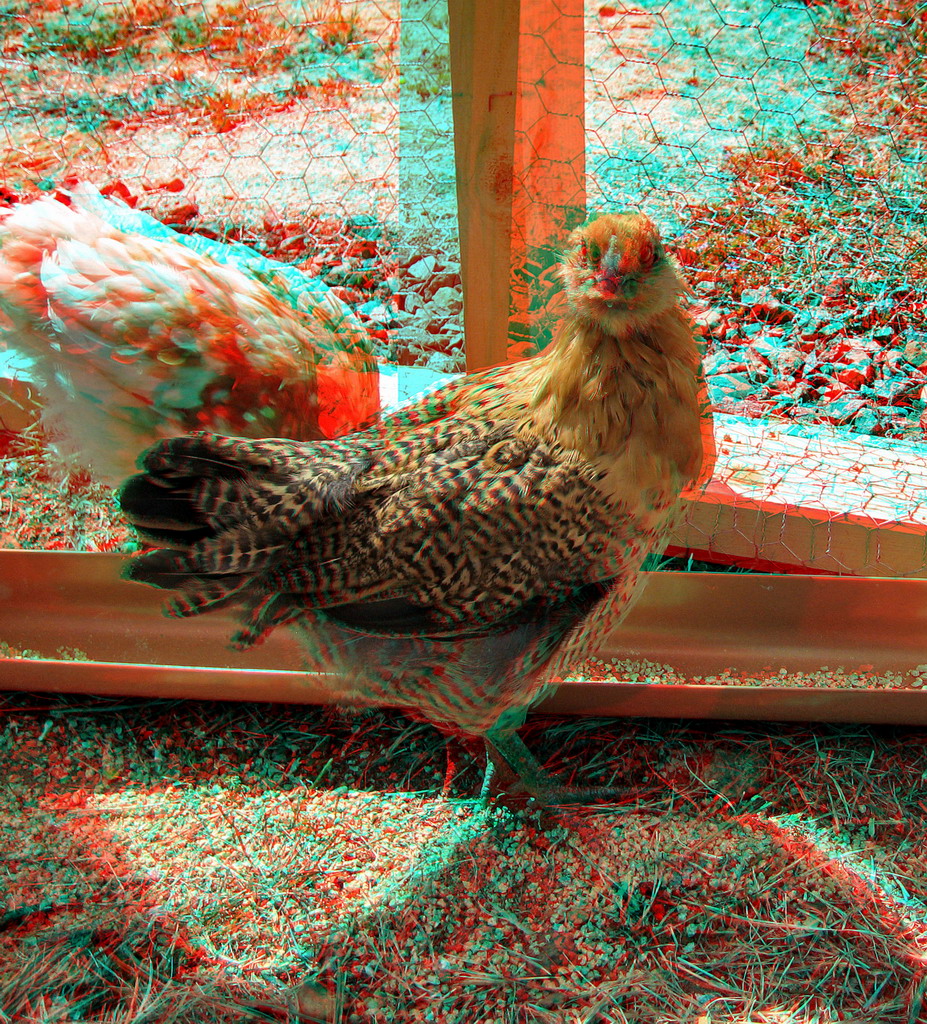
Gracie
Next is Gracie. She is named Gracie because she lays blue and green colored eggs or "Easter Eggs". She is an Araucana/Americana and is very shy and skittish around people and does not like to be handled. She is a beautiful bird and notice she has green skin on her legs and feet! Click here to see the 3D image of Gracie (anaglyph 3D glasses required).


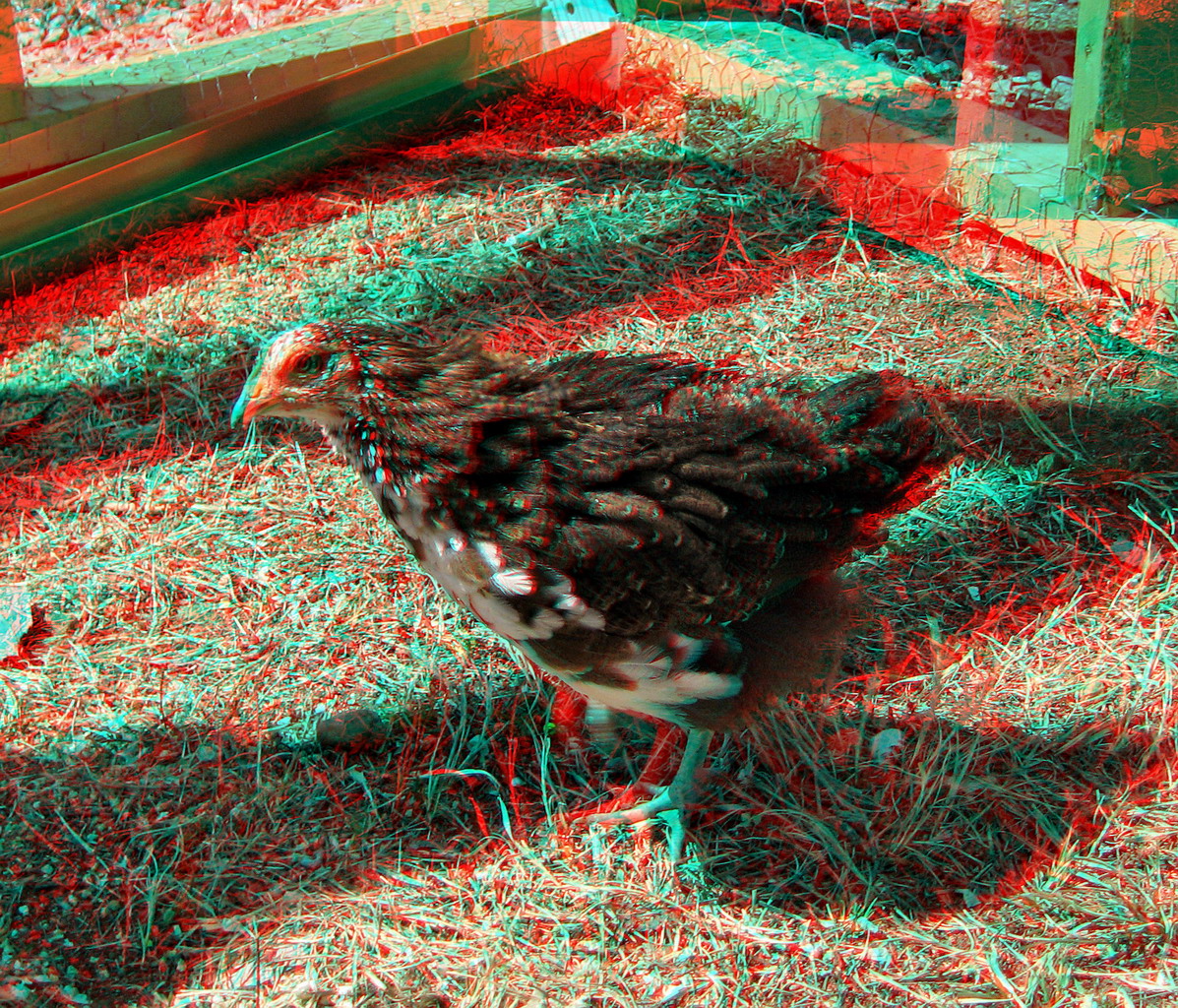
Leia
This is Leia, a Speckled Sussex. She is a little shy, but will take food from your hands and will lay brown eggs. Click here to see the 3D image of Leia (anaglyph 3D glasses required).


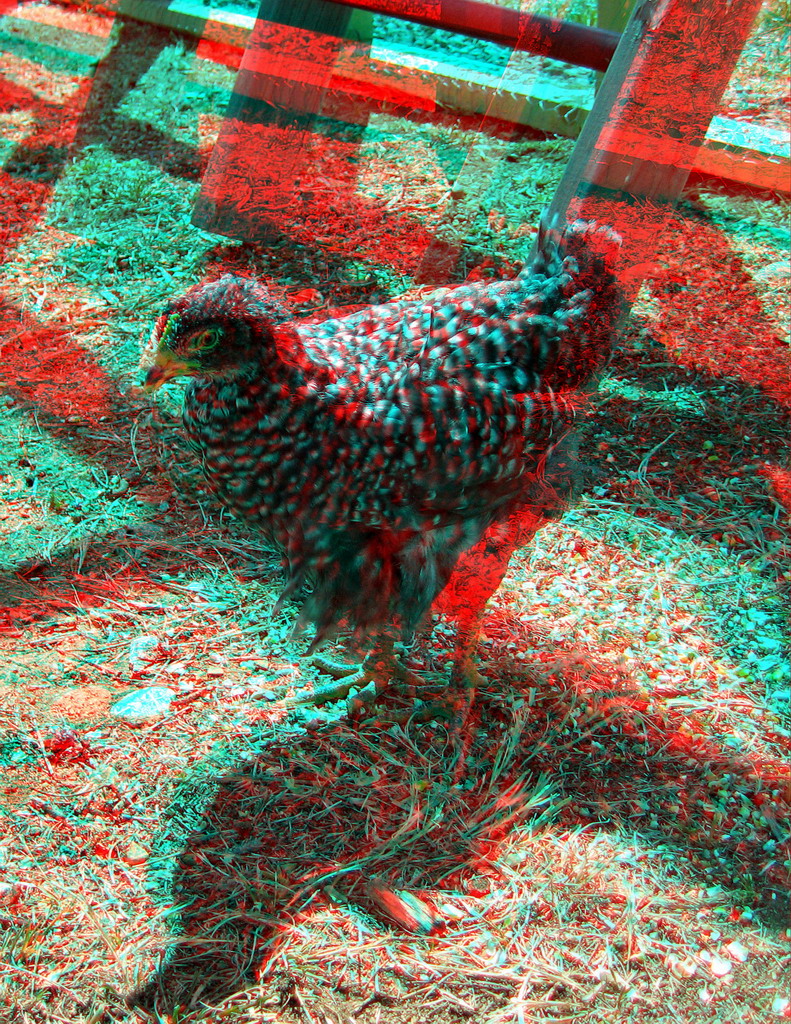
Ankita
Finally we have Ankita the Plymouth (Barred) Rock. She is friendly and even tempered. She will also lay light brown or pinkish eggs. Click here to see the 3D image of Ankita (anaglyph 3D glasses required).

Below is a photo of their new chicken coop and run:
We have to net the top of the run, to keep the hawks and eagles from stealing our chickens. The coop was painted to match our barn.

Friday, April 24, 2009

Queen release and other troubles

Well last weekend was cold and rainy and we weren't able to check up on the newly installed colony. I took today off and it was warm and dry, so we went to check to see how the bees were doing. We expected to see all the burr comb in the empty space where the queen cage was hanging, but we didn't expect to see the new Queen still inside the cage! To our horror the bees did not eat through the marshmallow and release her in 13 days. Instead they built burr comb over the opening, sealing her inside.

She was still alive and being fed by attendants through the screen. We quickly released her and she dropped into the hive with her attendants. But was it too late? Some of the burr comb had a new queen cell. It takes 16 days to produce a new queen, but when did they give up on the caged queen and decide to produce another? Will she be accepted now? Will she begin producing? Stay tuned for another update next week.

On to the surviving colony from last year. This hive was weak, but somehow survived the winter. There was new brood, but we did not find the queen. The brood patterns looked good and there was still some stored honey remaining. We hope this colony is now past the worst and will recover fully. Here is a picture of the brood from today's inspection:
Brood Pattern

We had some good rain last week and everything is greening up nicely. The dandelions are in full bloom and our fruit trees are just about to pop. We hope this translates into a good nectar flow soon.

Sunday, April 12, 2009

A Fresh Start

We got a new package of Minnesota Hygienic bees and put them in this weekend. Between the cloud cover and rain, there was only a narrow window where it was warm enough and we took advantage.
New Bees
See a 3D version of this picture here.

Removing the Queen
Removing the queen cage from the package.
View a 3D version of this picture here.

Dumping the Bees
Shaking the bees into their new home.
View a 3D version of this photo here.

BTW, Becky was the excellent sterographer for these pictures.

Saturday, March 14, 2009

Colony Collapse Disorder?

It was a warm sunny day today and fearing the worst after seeing no activity from the hive in the past few weeks, I opened up the Italian hive today to find them substantially gone:
They're gone!

There was about 40lbs of honey still in the hive, so they didn't starve. It has been a mild winter and they have been well protected, so they didn't freeze. In today's inspection I found only a small handful of bees still present:
The last of the Italians (RIP)
These few remaining bees were just barely alive and hardly moving. They were as good as dead (RIP). I did not find a queen present and there has been no brood of any kind since last fall. These were very productive bees during the last season and always were gentle. They will be missed, but replaced by another colony of Minnesota Hygienic Bees coming next month.

We also inspected the other colony of Minnesota Hygienics today. They are still very much alive and seem as vigorous as usual. They were out gathering pollen from somewhere and still had a good population and significant honey stores. However we are still concerned as we did not find any brood in the larvae stage today. While we did not spot the queen, it looks like she must be there somewhere. There were no queen cells and only a very small quantity of capped brood.

More info on CCD (videos): TED

Sunday, January 18, 2009

Warm January Day

Still concerned about the survival of our bees this winter, I took advantage of the warm weather today to have a look at the Italian colony, which is the one that seemed to be in the most trouble. The good news was they are still alive!
Small Winter Cluster
This photo shows a rather small cluster pattern for a warm day, which confirms the lower population of this colony.
The most amazing thing was that there was now MORE honey stores than we had placed in the hive during the November 1st inspection, when we first noticed they were in trouble.

Honey Stores
I counted six full frames about like this one mostly untouched in the upper box. Even those in the very center had not been consumed.

We were encouraged by these findings today and still hold out hope that both colonies will survive through the winter.

Sunday, January 11, 2009

January Wildfires!

This week we had the Chinook winds, which are typical for this time of year. We had some wind gusts that peaked at 55 MPH and lost some shingles from the house. But these warm, dry winds also accelerated a local wild fire in central Boulder County. At a time when snow is usually covering the ground, it seems odd to have fires this time of year.
Boulder County (Neva) Wildfire at 7:30PM
The Old Stage/Neva fire can be seen from our webcam snapshot above as the bright flare in the center of the image. Click the photo to see the full size, high resolution image.

The Daily Camera map below shows the exact location of the damage, which was about 8.6 miles west of our house.

Daily Camera News Story

Photo and video Gallery of fire

The Satellite image below is from the RockyMountain News story:

High-resolution DigitalGlobe satellite Imagery (PDF)

Denver Weather Examiner Story here.

Sunday, December 28, 2008

Still Alive

We've had an extremely cold December this year, with record low temperatures. On the 15th we set new records of -19F and had an average daytime temp of -6F. For the past week it has warmed up somewhat and our 7-day average was +23F, which matches the average temp for the whole month. Today felt like summer again with highs reaching into the mid-50s with warm sunshine. This change brought the bees back out for some cleansing flights and some foraging.

We were relieved to see they were still alive after the cold weather and their dangerously low stores. Since they were almost out of food, I took the opportunity to feed them a bit of honey and let them have a pollen patty. They took to the honey, but didn't seem too interested in the pollen patty today. Anyway, it looked like both colonies were quite alive and active today, which is good news.

Monday, November 10, 2008

2008 Garden Harvest Summary

Here it is almost Thanksgiving again and a great time to review the year's harvest totals and give thanks for the blessings from our garden.

As of Nov 10, most of the 2008 harvest is in(we still have a few carrots remaining). We had a bumper crop of honey this year and the bees were also busy in the garden with pollination.

We set new records this year for production of green beans, tomatoes. We lost our cucumbers and a few squash plants to bugs, but still did well on those. We missed most of early summer due to travel so the early crops like rhubarb, lettuce and cilantro were way down.

2008 harvest totals:
  • Basil (not measured)
  • Cantaloupe 2.0 lbs (why bother?)
  • Carrots 34.3 lbs (so far)
  • Garlic 0.5 lbs (volunteers)
  • Green Beans 26.9 lbs (new record)
  • Honey 312 lbs (new record)
  • Beeswax 3 lbs (new category)
  • Lettuce & Salad Greens 1.5 lbs
  • Onions 18.2 lbs
  • Peppers 62.1 lbs
  • Pumpkins 57.5 lbs
  • Rhubarb 7.0 lbs
  • Shallots 0.7 lbs
  • All Squash 322 lbs
  • Tomatoes 357.6 lbs (new record)

Fresh Onions
2008 Climate Summary:
The length of this summer's growing season was a bit longer than normal. We had our last frost of spring on May 11th and our first frost of the fall on October 7th giving us a little longer than normal 149 days of growing season. We had good rains in May and August this year, which probably helped the nectar flow for the honey production. Our total summer rainfall was also very close to normal with 7.94" from April through October with July being our driest month with zero rainfall the whole month. June was also dry, so the mid-summer required a lot of extra watering again this year.

Average temps were generally equal to last year through July, again without any days above 100 degrees. We had our only 100 degree day in early August, then it was a bit cooler from August through October compared with normal averages.

Wednesday, November 05, 2008

To Bee or Not to Bee

Anyone who has watched the news or picked up a newspaper lately has been witness to the extreme position in which the human race has placed itself. The precarious feeling of standing on a teeter totter with one foot trying to balance feeding the world, while the other is trying to balance nature and doing what is best for the earth. In one part of the United States we see farmers trying to defend their crops against the invading pests and just a few miles away we find a commercial beekeeper opening his hives to find that he lost up to 80 percent of his colonies over the winter. These two situations may not seem related but in fact they both have a common theme, the honeybee. This small, flying insect that seems to be as much a part of spring and summer as the gardens and flowers that they pollinate is in danger. It faces threats on every front. Unfortunately, we as a human race, are responsible for many of these threats from the pesticides that we use to the way we handle the bees. If these issues are not addressed soon, we could lose a valuable part of our food and our future.

The honeybee has been pushed into the news recently with the mysterious disease that is called, Colony Collapse Disorder, or CCD. During the winter of 2006-2007, there was a reported loss of 30% of all the hives nationally with the winter of 2007-2008 reporting 37% loss (Mendes 2). This is devastating news to the world’s food supply. According to the United States Department of Agriculture, every 3 out of 10 bites of food we take is thanks to a honeybee. They are directly responsible for pollinating crops like blueberries, almonds, squash, cucumber and most fruit grown on trees. They pollinate 15 billion dollars worth of food grown in America, annually (CSBA 1). With these figures in mind, the world is racing to find a reason for CCD. So far, there have been many theories ranging from pesticides to bad nutrition, but there is not a definitive answer. Perhaps, it is because it is not just a single cause but a combination of causes that have been waiting like a time bomb to explode.

Bees are an insect and they are not the only insect that is part of the equation. There are insects that are good for plants like bees, ladybugs and preying mantis. These insects pollinate and keep other insects that would destroy a plant under control. Then there is another insect that will eat and destroy crops. Farmers deal with the threat of these other insects destroying their crops. According to the Southeast Farm Press, this past June farmers faced the loss of their corn crop due to the stink bug. These insects can survive over the winter in wheat fields that were plowed in the fall and will be then planted in the spring with corn (Robinson 9).

Corn is important to the economy not only for food, but with the demand to steer away from the use of fossil fuels. With Ethanol now being produced from corn and used as another way to fuel cars, farmers are turning over more fields for growing corn. If their crops are destroyed they lose not only their income but America loses a valuable fuel source. Unfortunately, many of the choices that the farmers have in killing destructive pests also kills the other insects like the honeybee. One solution that farmers use is neonicotinoids. This is a group of pesticides that were introduced on the market in the mid 1990’s. “Basically, neonicotinoids block the insect neural action. In other words, affected insects often just sit around doing nothing until they desiccate, get sunstroke or become picked off by a predator or disease” (Shetlar 80).

So far, these pesticides have been effective in preventing pests, but at what cost? The pesticides that fall under neonicotinoids, which includes clothianidin, have already been banned in Germany and a similar insecticide banned in France. Germany’s Federal Agricultural Research Institute is quoted by the Sierra Club as saying, ”It can unequivocally be concluded that poisoning of the bees is due to the rubbing-off of the pesticide ingredient clothianidin from corn seeds” (Harmon par. 3).

The response to these actions in Europe has fueled the debate here at home but with the income and need for corn being so great it has been harder to get action. According to the Colorado State Beekeepers Association website, the Natural Resources Defense Council has filed a lawsuit against the Environmental Protection Agency, (EPA), for “withholding the toxicity of pesticides to bees”, they also are stating, “EPA granted a registration to a new pesticide manufactured by Bayer CropScience under the condition that Bayer submit studies about its product’s impact on bees” (CSBA 1). The pesticide in question, being manufactured by the Bayer Company, is one of these neonicotinoids. Why would the EPA not release the results of these findings? We could make lots of conclusions one of which could be the money that the Bayer Corporation has to help hide the issues. Let us not forget what David Hackenburg of the U.S. Department of Agriculture said, “Massive bee die-offs started occurring after regulatory agencies rubber stamped the use of neonicotinoid spraying and coatings” (Harmon par.7) .

Pest destroying our crops is not the only issue we have to take into account. There are also pests that are destroying the bees. During the mid 1980’s a threat was found to have invaded the U.S. beehives. This tiny threat is the mite. It has also had a devastating affect on the survival of our honey bees. The two main mites that can destroy a hive is the Varroa and the Tracheal mite. These mites have not been attributed as a cause of CCD but the way we treat this threat might be. Again the issue is a pesticide but this time it is one that the beekeeper used directly in the hive.

When the mite emerged on the scene, beekeepers rushed to find an answer and a quick fix. Keep in mind that commercial beekeeping is also a big money maker. Trucks carrying hives of bees are transported around the country to pollinate a specific crop. When the bees are done they will be packed up and moved to another field, perhaps across the country. If farmers do not have bees then their crops will not produce. Again we find ourselves on a teeter totter deciding between money and food and the bee. In response two hard pesticides were presented.

The first miticide to appear was Apistan and when mites became resistant to that then CheckMite entered the market. According to Bee Culture Magazine, “It is well known that both the above materials accumulate in the comb and can cause if not acute, at least persistent ongoing problems that interfere with the delicate biology of a honey bee colony” (Sanford 19). Keep in mind that both of these “miticides” are still sold in beekeeping catalogues today and even encouraged to be used. In the book, Beekeeping for Dummies, written by Howland Blackistan he says, “Regardless of whether you detect varroa mites, I suggest that preventative miticide treatments be administered to your hive once in the spring and again in autumn” (A180).

The fear of what might happen is often the reason preventative medicines are used. We have seen this example in humans. For too long doctors prescribed antibiotics to children to prevent them from getting sick and now we have found that many diseases have mutated or become resistant to the very thing we used to prevent it. So too is the case with the bee. Bees, like humans, have always had a chance of getting sick from certain diseases. Foulbrood is one such disease. The way to treat it is antibiotics.

Antibiotics are helpful when used correctly. That statement is also true when caring for a hive today. The problem is that many beekeepers feel pressured to give these antibiotics regularly as part of their seasonal management of their hives. They have been scarred by the threats that bees are facing and trying to keep up with the quick fixes that we as humans try to pass off as science. Bruce Royden Brown of CC Pollen Co explains, “Science tries to present a stable picture of its findings and in the end, it’s only partial, fragmented truth that is always moving”. He also adds, “Most science is driven by economic, profit driven pressure”(A1). In the end, a beekeeper is once again trying to perform a balancing act, how to protect their hive from disease and how to stop the weakening trend of bees in general.

Any beekeeper who has lost a hive can tell you of the guilt that is felt. To see a hive become sick or weakened, to open a hive at the end of a long winter only to find that it is dead or queenless is a beekeepers nightmare. They find themselves asking what they could have done to prevent it and could they have done more. These are the feelings that companies who sell the medicines and antibiotics play upon when selling their products.

Let us try to imagine the guilt that would be felt if we lost the bee population. Could we survive the loss of such an important part of our ecosystem? Bees have survived for millions of years without the aid of humans but may be destroyed by the science of humans. In our response to this situation we need to step back and take a look at the bigger picture. Colony Collapse Disorder is the current disaster hitting our environment but it’s really just a consequence of our over indulgent behavior concerning pesticides and our intrusive behavior into a highly organized part of nature. If we are going to succeed in balancing food and nature we need to take money out of the equation. Perhaps Bruce Royden Brown said it best, “Go back to the basics; give the bees what they need…It is vitally important for us as human beings, maybe even for reasons beyond our comprehension” (A4).


Works Cited

Blackiston, Howland. Beekeeping for Dummies. New York: For Dummies, 2002.

Brown, Bruce R. "Bee Nutrition & Bee Medication: What the bee Really is not What it is Getting." Total Health 08 Mar. 2008. 24 Sept. 2008. EBSCOhost. Front Range Community College, Longmont. 24 Sept. 2008.

Harmon, Alan. "The Sierra Club Wants Neonicotinoids Treatments Stopped, Now!" CSBA. 23 Sept. 2008. Colorado State Beekeepers Association. 23 Sept. 2008 http://www.coloradobeekeepers.org/articles.htm.

Mendes, David, Vice President. “Health of Bee Pollinators”. Wash D.C.. FDCH Congressional Testimony. 24 Sept. 2008.

"National Resources Defense Council Sues EPA to Get Public Records on Pesticides." CSBA. 18 Aug. 2008. Colorado State BeeKeepers Association. 23 Sept. 2008 http://www,coloradobeekeepers.org/articles.htm

"Organic Farming Can feed the world...Can Conventional farming?" Natural Life Sept.-Oct. 2007: 40+.

Robinson, Ray. "Corn Growers given plant bug alert." Southeast Farm Press 04 June 2008: 7+.

Sanford, Malcolm. "CCD-The Role of Emerging Pests, Pesticides and Pathogens." Bee Culture July 2008: 19+.

Shetlar, Dave. "Get to Know Neonicotinoids." Landscape Management Apr. 2008: 78+.

----------

This above was an English paper written by Becky Broberg, © September 25, 2008

Sunday, November 02, 2008

Pesticide impact?

A brief update on the hive troubles: We continued feeding today with leftover honey. We made about 8 lbs available for each colony in the hive-top feeders. It was certainly warm enough for them to take it today. We'll see how much we can get them to pack away before it gets too cold.

I spoke to the former president of the local bee club today. He said this problem seems to be fairly widespread throughout Boulder County this year. He has some theories that it may be related to neoniconoids (a type of pesticide) being used on local corn crops. His advice was add a pollen patty to affected hives to see if that will get the queen laying again.

More resources on connections between neoniconoids and colony collapse disorder (CCD):
USDA website article
Bee Culture Article

Saturday, November 01, 2008

They're in trouble!

We've had some nice warm weather this week and the wind was calm so we did an inspection today, Nov 1. What we found was rather disturbing. The bees, both hives are in real trouble now, and just a few weeks ago everything looked great. Most of their honey reserves were gone and there was virtually no brood. What happened? Will we loose them?


This frame is one of the best frames from the upper deep of Hive-1's honey reserves, most were completely empty. Just 4 weeks ago, these were completely full.


Going downstairs to the brood chamber revealed frames like this. Most were just empty and a few had some pollen and we saw only about a few dozen cells with capped brood, no eggs, no larvae, just empty cells. Are they queenless?


Hive 2 wasn't doing much better. We found most of the frames empty and in the uppermost chamber there were just four frames at the far north end of the hive that still had capped honey like this one. Since they seldom venture to the north end of the hive during the worst of winter, I decided to move these 4 frames with the honey closer to the middle of the upper chamber.


Hive 2's brood chamber was also mostly empty now. Like hive 1, we saw a few cells with some pollen and just a few cells with capped brood, but no eggs, no larvae and very little honey. We couldn't find the queens today from either hive. Hive 1 was quite agitated and we ended up having to put our gloves on in the mayhem, which made it a bit hard to snap some pictures.

In our panic, we decided they urgently needed some food. After we closed up the hives I went back and returned with 8-10 partially capped frames we didn't harvest from September. Most had open cells of nectar and a few were partially capped with honey. I set these about leaning against the hives for feeding and they were all over them in just a few minutes. They were having a feeding frenzy the rest of the afternoon. We have a bit more unprocessed honey we will try to feed them tomorrow, but if they are really queenless, it probably won't help.

These bees were so good to us this past season with the tremendous production and now it looks like something has gone terribly wrong. We hope they find a way to make it somehow.

Saturday, October 25, 2008

Halloween Bees

Our son was playing in the marching band at the Longmont Halloween Parade today, and I couldn't help snapping a few shots of the cute little bees.


Even the little dogs were dressed up like bees today!