Here is an early sign of springtime for us. This is a time-lapse video of the first bloom of our Valentines-Day Orchid.
Wednesday, February 20, 2008


Saturday, February 16, 2008
Winter Losses
It was a tough winter for Becky's Bees. The Hive #1 that perplexed us most of the year, finally fell victim to what ever disease had afflicted them. As noted in our October entry from last fall, we found this hive in bad shape during that inspection, but didn't know what the problem was.
Here are some of the conditions we observed:
The population of bees seemed good.
The bees were easily agitated during the inspection.
A few yellow-jackets were observed (under attack) while inspecting.
The upper and lower deeps were nearly void of all honey stores!
The brood area was spotty with some dead bees just emerging in brood area with their tongues outstretched (See photo). But, we didn't see any sunken or punctured cappings. Nor did we see any melted down larvae or black scale.
We had already treated for mites and we began feeding them immediately. The queen was also seen during the inspection (see photo). Also we observed no drones during this inspection, while during the summer they were several. But I think they have probably been given the boot by the ladies at this point in the season.
After we had a full top-feeder with that sweet syrup on for two weeks, they were not interested! Surprisingly there is no evidence they took any! We went out after the first week and topped it off, and checked again after two weeks and there might have been some evaporative loss, but very little if any. Also there were no visible bees in the screen area near the feeding opening.
We've had plenty of warm days in the first two weeks we fed them. We also saw them circulating about and even some congestion at the entrance late in the day.
We had some warm weather again on November 11, so we did another inspection of the troubled hive. There was some good news which was encouraging, but further mystery surrounds this hive.
First, we were all prepared to take the upper deep and push them down to just one deep for the winter, but when we opened the hive, we found good news - HONEY and lots of it. Mysteriously, there were now several very heavy frames completely capped with honey in this hive. I would estimate the upper deep at 50%-60% capped honey by that time! The frames that weren't full, were being worked furiously to store necter and get it capped. Here's a photo of one of those frames not yet filled:

Full Size Image
The mystery goes to the source of this new found honey. The top feeder was still full and there were still almost no bees feeding from the syrup in the top feeder. Where did they get all these new stores? Maybe they stole this honey from somewhere else?
Strangely, we also did see a number of dead yellow jackets floating in the syrup. How they got in, is also a mystery. Perhaps this is what made the syrup unappetizing for the bees? We cleaned it up and removed the dead yellow jackets, but left the syrup. Here is what that looked like:

Full Sized Image
Finally, we did see some brood and larvae in the upper frames:

Full Size Link
We also saw the queen on one of the brood frames, but didn't get a photo this time. After all this, we decided to leave the upper deep and keep feeding. I was a bit more hopeful they will make it by this time. I also saw one stray yellow jacket on the frames while we were inspecting and one later on the hive cover after we closed it up, but how they got into the hive-top-feeder has us puzzled. There were some small cracks between the frames, which seemed to be attracting some attention from the outside. Perhaps the yellow jackets were squeezing through? To make sure that wasn't happening, I sealed the cracks with some duct tape.
On January 5, 2008, we finally had another warm day and I went out for another look. The troubled hive was still alive with quite a few bees going in & out for some fresh air. However, it seemed to have a dysentery problem. That must have been what weakened them last winter and we didn't catch it.
Here are the shots I took when they were out on January 5th 2008:

Full Size Image Link

Full Size Image Link
And these pictures were taken of on January 26th showing the condition of the outside of the hive:

The troubled hive. Full Size Image

The healthy hive nearby. Full size image
The second hive seemed immaculate by comparison. At this point we were pretty sure it was some form of nosema. (Nosema causes dysentery and weakens the hive, reduces production, etc.) They were seen flying about on January 28th, but we didn't open the hive to see how many were alive.
On February 13th, we had another day in the 70s, but the battle had ended, the disease won, the bees lost.
BeeGood went out that day to assess the condition of the hives. There were a few bees out taking cleansing flights, but inside was a sad story. Most of the frames in the upper deep had clusters of dead bees. Many died with their heads deep into the comb, but even more died just as they were standing, stuck permanently in a somewhat natural pose. This picture shows there was some remaining bee-bread in the comb right where they died. Some honey was also found in other frames but very little - they surely starved. There were many small groups of dead bees scattered throughout the hive. There didn't seem to be any single cluster. The bees in the photo below looked natural in the photo, but all were motionless and dead:

View 1200x860 image
With it pretty clear they had nosema, I'm beginning to wonder if this was a case of the more severe Nosema ceranae strain.
Randy Oliver wrote:
More from Randy Oliver on Nosema: http://www.scientificbeekeeping.com/index.php?option=com_content&task=view&id=48
The good news was that the nearby hive #2, seems to be doing much better. After a quick peek into that hive, she verified that they still had good supplies of honey stores and had a much larger population. She decided not to start feeding after inspecting two nearly full frames, near the center of the upper box. This second (healthy) hive also seems to be amazingly clean compared to the dead hive. The wax and comb appears clean and very light colored, while the dead hive has very dark colored comb.
Here are some of the conditions we observed:
The population of bees seemed good.
The bees were easily agitated during the inspection.
A few yellow-jackets were observed (under attack) while inspecting.
The upper and lower deeps were nearly void of all honey stores!
The brood area was spotty with some dead bees just emerging in brood area with their tongues outstretched (See photo). But, we didn't see any sunken or punctured cappings. Nor did we see any melted down larvae or black scale.
We had already treated for mites and we began feeding them immediately. The queen was also seen during the inspection (see photo). Also we observed no drones during this inspection, while during the summer they were several. But I think they have probably been given the boot by the ladies at this point in the season.
After we had a full top-feeder with that sweet syrup on for two weeks, they were not interested! Surprisingly there is no evidence they took any! We went out after the first week and topped it off, and checked again after two weeks and there might have been some evaporative loss, but very little if any. Also there were no visible bees in the screen area near the feeding opening.
We've had plenty of warm days in the first two weeks we fed them. We also saw them circulating about and even some congestion at the entrance late in the day.
We had some warm weather again on November 11, so we did another inspection of the troubled hive. There was some good news which was encouraging, but further mystery surrounds this hive.
First, we were all prepared to take the upper deep and push them down to just one deep for the winter, but when we opened the hive, we found good news - HONEY and lots of it. Mysteriously, there were now several very heavy frames completely capped with honey in this hive. I would estimate the upper deep at 50%-60% capped honey by that time! The frames that weren't full, were being worked furiously to store necter and get it capped. Here's a photo of one of those frames not yet filled:
Full Size Image
The mystery goes to the source of this new found honey. The top feeder was still full and there were still almost no bees feeding from the syrup in the top feeder. Where did they get all these new stores? Maybe they stole this honey from somewhere else?
Strangely, we also did see a number of dead yellow jackets floating in the syrup. How they got in, is also a mystery. Perhaps this is what made the syrup unappetizing for the bees? We cleaned it up and removed the dead yellow jackets, but left the syrup. Here is what that looked like:
Full Sized Image
Finally, we did see some brood and larvae in the upper frames:
Full Size Link
We also saw the queen on one of the brood frames, but didn't get a photo this time. After all this, we decided to leave the upper deep and keep feeding. I was a bit more hopeful they will make it by this time. I also saw one stray yellow jacket on the frames while we were inspecting and one later on the hive cover after we closed it up, but how they got into the hive-top-feeder has us puzzled. There were some small cracks between the frames, which seemed to be attracting some attention from the outside. Perhaps the yellow jackets were squeezing through? To make sure that wasn't happening, I sealed the cracks with some duct tape.
On January 5, 2008, we finally had another warm day and I went out for another look. The troubled hive was still alive with quite a few bees going in & out for some fresh air. However, it seemed to have a dysentery problem. That must have been what weakened them last winter and we didn't catch it.
Here are the shots I took when they were out on January 5th 2008:
Full Size Image Link
Full Size Image Link
And these pictures were taken of on January 26th showing the condition of the outside of the hive:
The troubled hive. Full Size Image
The healthy hive nearby. Full size image
The second hive seemed immaculate by comparison. At this point we were pretty sure it was some form of nosema. (Nosema causes dysentery and weakens the hive, reduces production, etc.) They were seen flying about on January 28th, but we didn't open the hive to see how many were alive.
On February 13th, we had another day in the 70s, but the battle had ended, the disease won, the bees lost.
BeeGood went out that day to assess the condition of the hives. There were a few bees out taking cleansing flights, but inside was a sad story. Most of the frames in the upper deep had clusters of dead bees. Many died with their heads deep into the comb, but even more died just as they were standing, stuck permanently in a somewhat natural pose. This picture shows there was some remaining bee-bread in the comb right where they died. Some honey was also found in other frames but very little - they surely starved. There were many small groups of dead bees scattered throughout the hive. There didn't seem to be any single cluster. The bees in the photo below looked natural in the photo, but all were motionless and dead:
View 1200x860 image
With it pretty clear they had nosema, I'm beginning to wonder if this was a case of the more severe Nosema ceranae strain.
Randy Oliver wrote:
Amazingly, in a few short years N. ceranae appears to have supplanted N. apis throughout much of North America and the world! In many areas, it is now difficult to find the previously common N. apis!... One European researcher feels that we have been so distracted by varroa, that we have simply overlooked the poor buildup, queen failures, poor honey crops, and colony collapse due to N. ceranae.
The good news was that the nearby hive #2, seems to be doing much better. After a quick peek into that hive, she verified that they still had good supplies of honey stores and had a much larger population. She decided not to start feeding after inspecting two nearly full frames, near the center of the upper box. This second (healthy) hive also seems to be amazingly clean compared to the dead hive. The wax and comb appears clean and very light colored, while the dead hive has very dark colored comb.
Thursday, November 22, 2007
2007 Harvest Summary
Thanksgiving is a great time to review the year's harvest totals and give thanks for the blessings from our garden.
This summer's growing season was longer than usual. We had our last frost of spring on May 8th and our first frost of the fall on October 8th giving us a very long 153 days of growing season. Our summer rainfall was also very close to normal with 7.63" from April through October with June being our driest month with only 0.27" of rainfall this year. July was only slightly more, so the mid-summer required a lot of extra watering this year. Average temps were generally lower through July this year too, with no days above 100 degrees. August through October was slightly warmer than normal, helping to achieve the late frost.
As of Nov 22, most of the 2007 harvest is over (we still have a few carrots remaining). We didn't set very many records this year, but we had a right-sized harvest. We intentionally cut back on some veggies to better match our consumption. We also had some trouble with squash bugs that totally destroyed our winter squash & pumpkins this year. While the peppers did well, we had some early losses due to high winds and had to replant some varieties from the nursery.
- We set new records this year for production of garlic and peppers, but with the busy fall football season, we totally missed the garlic planting time and won't have any next year.
This year's harvest totals:
- Basil 0.9 lbs
- Cabbage 3.2 lbs
- Carrots 33.3 lbs (so far)
- Cucumber 15.2 lbs
- Garlic 8.1 lbs (new record)
- Green Beans 9.6 lbs
- Honey 34.2 lbs
- Lettuce & Salad Greens 9.3 lbs
- Onions 20.2 lbs
- Peppers 87.1 lbs (new record)
- Rhubarb 11.9 lbs
- Snow Peas 1.7 lbs
- Summer Squash 49.5 lbs
- Tomatoes 171.4 lbs
This summer's growing season was longer than usual. We had our last frost of spring on May 8th and our first frost of the fall on October 8th giving us a very long 153 days of growing season. Our summer rainfall was also very close to normal with 7.63" from April through October with June being our driest month with only 0.27" of rainfall this year. July was only slightly more, so the mid-summer required a lot of extra watering this year. Average temps were generally lower through July this year too, with no days above 100 degrees. August through October was slightly warmer than normal, helping to achieve the late frost.
Saturday, October 20, 2007
October 20 Inspection
This was the first deep inspection we've done in several months. Here are some photos. 
The first one shows the first bad news we saw from Hive#1. This is one of the center frames from the upper deep. This time of year, this frame should be filled with capped honey, which will be used late in the winter or early spring as the cluster moves up in the hive. If the frames are empty now, they will starve later this winter. To keep them from starving we will try to feed them as much as they will take until the temps get too cold to feed.

This next photo shows what we saw deeper in the hive. This brood area is showing two partially emerged bees, that were sadly found dead during our inspection. This is more bad news.

This last picture from Hive #1 shows the new queen. We haven't seen the queen of this hive since late spring when we had the swarming troubles. This confirms that we did loose our original queen, and this is the one that superseded. Our tentative plan is to replace her in the early spring, if this hive survives then winter.
Now on to Hive #2, where things looked a bit more normal and a bit more encouraging:

This is one of the frames fully packed with capped honey in Hive #2. they seemed to have an excellent supply of reserves.

This is the original queen from Hive #2. She remains in charge of the hive and has the original markings (yellow dot) that helps identify her.
The first one shows the first bad news we saw from Hive#1. This is one of the center frames from the upper deep. This time of year, this frame should be filled with capped honey, which will be used late in the winter or early spring as the cluster moves up in the hive. If the frames are empty now, they will starve later this winter. To keep them from starving we will try to feed them as much as they will take until the temps get too cold to feed.
This next photo shows what we saw deeper in the hive. This brood area is showing two partially emerged bees, that were sadly found dead during our inspection. This is more bad news.
This last picture from Hive #1 shows the new queen. We haven't seen the queen of this hive since late spring when we had the swarming troubles. This confirms that we did loose our original queen, and this is the one that superseded. Our tentative plan is to replace her in the early spring, if this hive survives then winter.
Now on to Hive #2, where things looked a bit more normal and a bit more encouraging:
This is one of the frames fully packed with capped honey in Hive #2. they seemed to have an excellent supply of reserves.
This is the original queen from Hive #2. She remains in charge of the hive and has the original markings (yellow dot) that helps identify her.
Wednesday, September 12, 2007
2007 Honey Harvest

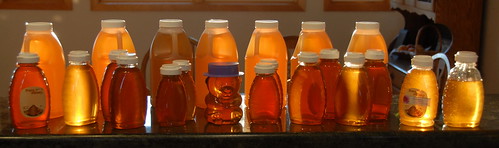
The harvest is done! It was nice and warm today and I took the day off to help with the honey harvest. It went a LOT smoother than last year, and the bees didn't seem too bothered by it all. I think this was mostly due to the more appropriate weather. (Note to self: Limit honey harvesting to sunny days over 80.)
While we took three supers from the two hives, the overall harvest was down significantly from last year's bounty. I guess we'll have to chalk this one up as a learning year. We sure had our share of troubles, which seemed to set the bees back considerably. Anyway the honey tastes great and we are very thankful for the 34 lbs we got this year.
Saturday, September 01, 2007
August 25th Inspection
Well, things continue to go slowly in hive #1. This photo shows the nice capped honey from the first super we installed back in June. Most of the frames were quite nice like this, but that is the way it looked a month ago. We were tempted to harvest this box now, but decided to wait and do everything together.
When we inspected the upper super, we found little or no activity. Many of the frames still have no drawn comb and are just sitting there waiting for some bees to get working. The second photo shows the same empty frame with a bit of pollen on it that we saw weeks ago. Little or no change.
Were not sure if this is weather related or what, but last year at this time we had far more honey being packed. We suspect the hive lost the queen and has made another, but is suffering from low productivity. We decided to rotate the supers and moved the nearly full super to the top and placed the nearly empty one lower on the hive.
The new hive seems to be fairing a bit better. Considering this hive had a late start this spring and was more than three weeks late, compared to the start of our first hive last year, they seem to be doing well. The population of the hive is up and they are now packing honey in the first super.
The photo shows one of the frames from the honey super with partly capped honey and the rest of the frame nearly full. Our plan is to let them keep working until the 2nd week of September, then harvest what ever we have.

When we inspected the upper super, we found little or no activity. Many of the frames still have no drawn comb and are just sitting there waiting for some bees to get working. The second photo shows the same empty frame with a bit of pollen on it that we saw weeks ago. Little or no change.

Were not sure if this is weather related or what, but last year at this time we had far more honey being packed. We suspect the hive lost the queen and has made another, but is suffering from low productivity. We decided to rotate the supers and moved the nearly full super to the top and placed the nearly empty one lower on the hive.
The new hive seems to be fairing a bit better. Considering this hive had a late start this spring and was more than three weeks late, compared to the start of our first hive last year, they seem to be doing well. The population of the hive is up and they are now packing honey in the first super.

The photo shows one of the frames from the honey super with partly capped honey and the rest of the frame nearly full. Our plan is to let them keep working until the 2nd week of September, then harvest what ever we have.
Sunday, July 29, 2007
Guest beekeeper
 For our July 29th inspection, we had a guest beekeeper. Our niece from Ohio came for a visit and helped with our inspection this week. The bees were very cooperative and offered a nice demonstration.
The #1 hive still seems to be stuck in suspended animation. No activity since last week that we could see. The upper super remains almost untouched.
Hive #2 has made some good progress since last week. This hive has three medium supers for the hive-body instead of the deeps. The third (upper) super is now about 80% drawn comb and is filled equally with brood and capped honey. We'll be adding our first honey super this week - hooray!

Saturday, July 21, 2007
July 21 Inspection
We checked the hives today and found little progress since we added the second super to Hive #1. There was some drawn comb, but no honey that we could see. It seems strange that we found one frame where the girls seemed to be packing pollen. This back-lit photo captured some of the colors of the pollen (and the bees!).
It seems that there is plenty in bloom lately and the bees are working the flowers long and hard, but what are they doing? Where is our honey?

It seems that there is plenty in bloom lately and the bees are working the flowers long and hard, but what are they doing? Where is our honey?
Saturday, June 23, 2007
June 23rd Inspection
June was a busy month! We haven't opened the hives for three weeks until today. We first took a look at Hive #1 and found the bees still present and busy. We noticed that the first honey super was about 80% capped! The bees were very calm today, so this was a good sign and we decided that if they are collecting honey and not bothered by our inspection all must be well in the decks below. We didn't open it up further to look for the queen or brood, but assumed all was well. We added the second super and closed it up. We will be getting honey this year, despite all our trials with the bees - hooray!
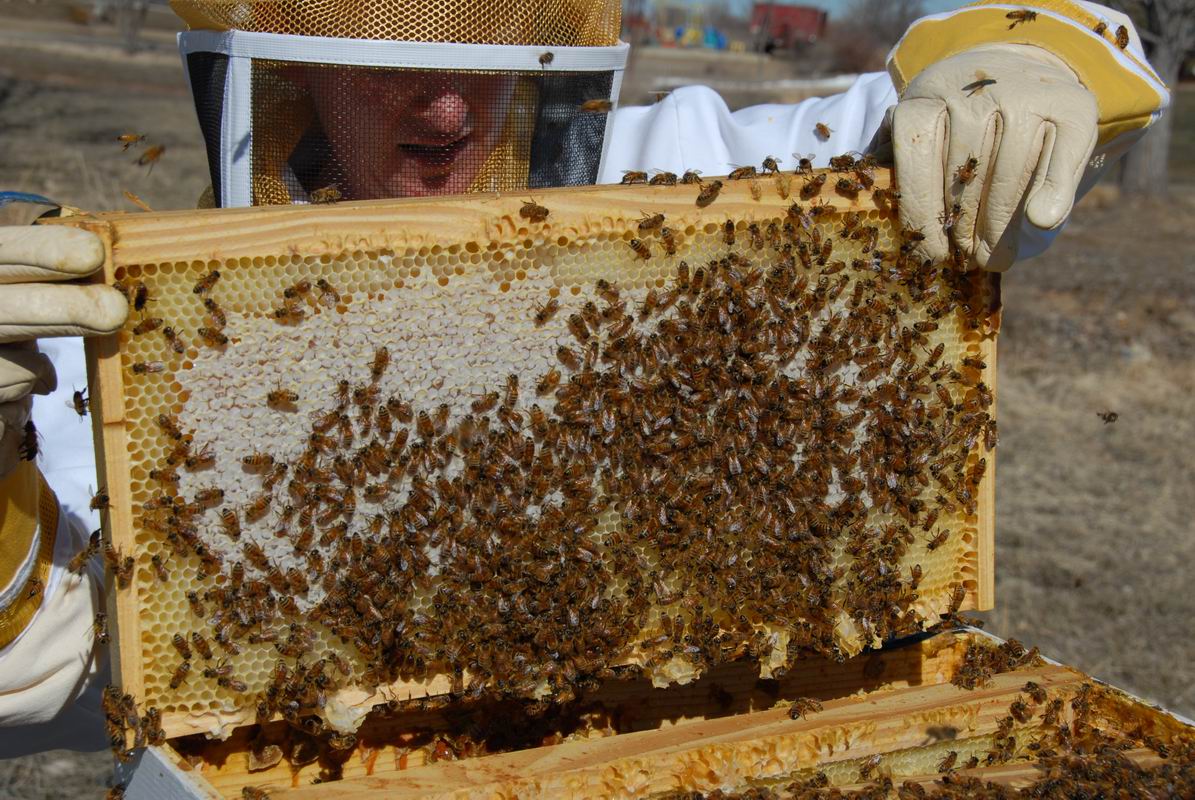
Next we opened up Hive #2. A month has passed since installation and there was already a good collection of brood, honey and pollen.

We also got a better shot of the queen (yellow dot) this time.

Notice that today, David has gloves on? After a accident with a screw driver earlier in the day, he didn't want to risk tempting the bees with the smell of his fresh blood.

Next we opened up Hive #2. A month has passed since installation and there was already a good collection of brood, honey and pollen.
We also got a better shot of the queen (yellow dot) this time.
Notice that today, David has gloves on? After a accident with a screw driver earlier in the day, he didn't want to risk tempting the bees with the smell of his fresh blood.
June 2, 2007: David is a Beekeeper too!
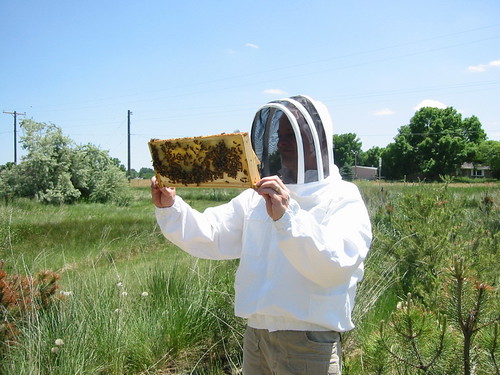 After returning from the road trip, David wasted no time doing an inspection of his new hive. This is his first inspection, after the hive has been installed for one week. Everything looked good for the new hive and he even got to see the queen. Notice in the pictures his hands are bare for this inspection.
If you click the photo and view the larger image, you may see that the queen (marked with a yellow-dot) is barely visible in this shot.
May 25th: New Package Installation
Just a few days after the swarm vacated Hive #2, David's new package of bees arrived from Georgia. They had been delayed by weather several times and it was getting late to install them. To make matters worse, they arrived after David had left for a long weekend away with Kenny.
Had the swarm stayed, I have no idea what we would have done with them. I guess it all worked out in the end.
Becky and Austin volunteered to do the installation while David was gone. Here are some snap-shots that Colin took of them installing the new package in Hive #2.


Had the swarm stayed, I have no idea what we would have done with them. I guess it all worked out in the end.
Becky and Austin volunteered to do the installation while David was gone. Here are some snap-shots that Colin took of them installing the new package in Hive #2.


Swarm update: May 20th, 2007
A lot has happened since our last post, here is a brief update. Later on the day of the capture, we noticed a huge crowd of bees on the front of Hive#1 (the original hive). We hadn't opened that hive, but it was within about 10 feet of the new hive where we placed the swarm. It appears as if the swarm was attacking our original hive.

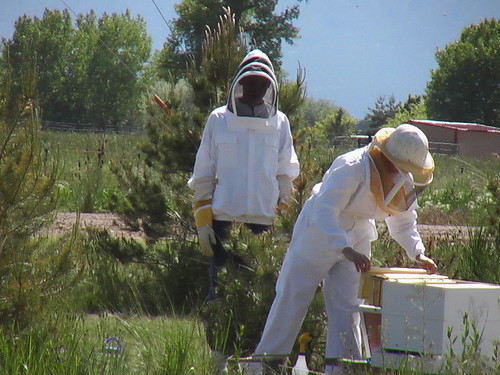
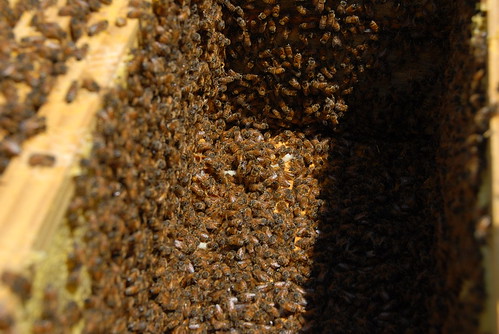
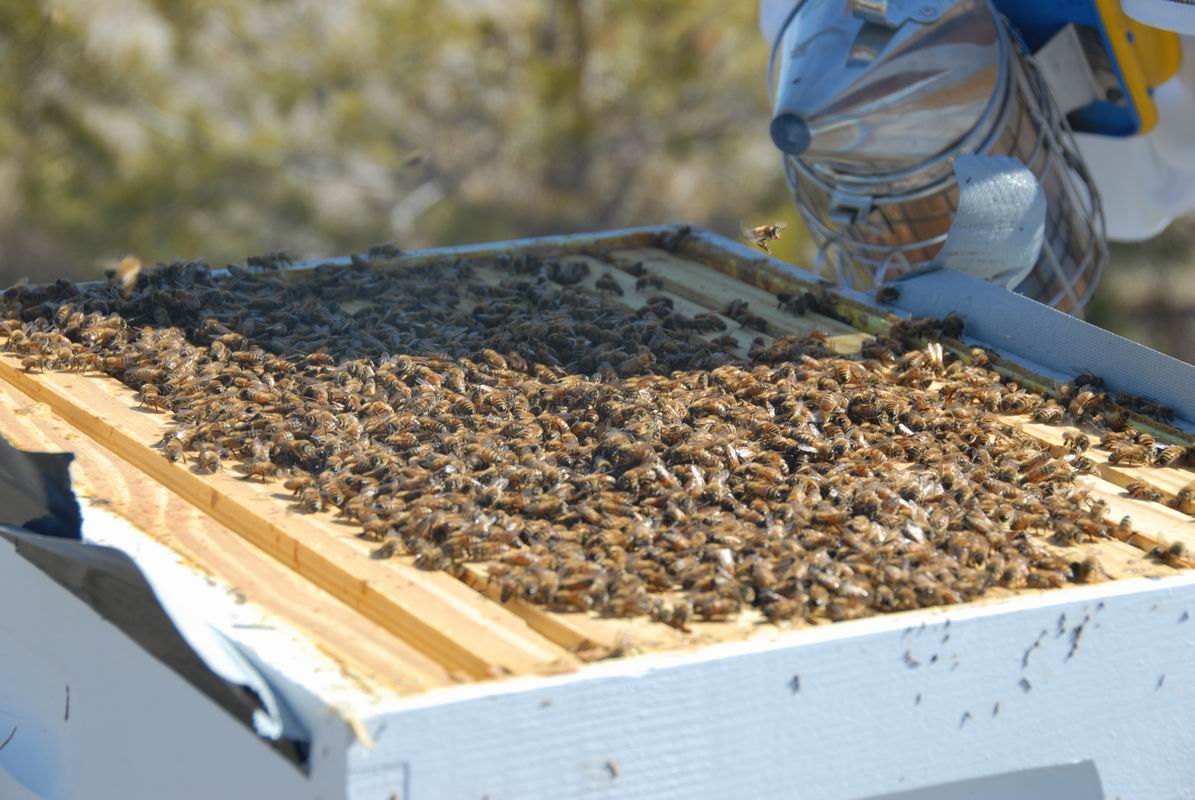
On May 20th (the next day) we went out to inspect. The photo below is the top of Hive #1. It seems to be more crowded than we've ever seen it. This makes us think one of three things happened:
A: It must not have been bees from our hive that swarmed, otherwise we would see few bees at home.
B: It was our own hive that swarmed, and they decided to return to the home base.
C: The new swarm wasn't satisfied with the new digs, and came over attacked and took over Hive #1.
Anyway, were not really sure what explains the very full hive at this point, see both of the photos below:

Later we opened the new hive (Hive #2 below). This was where we had just installed the swarm the day before. Guess what? Nobody was home! Where had they gone?
We sure don't have this beekeeping stuff figured out. If anyone has an explanation, please post a comment.

On May 20th (the next day) we went out to inspect. The photo below is the top of Hive #1. It seems to be more crowded than we've ever seen it. This makes us think one of three things happened:
A: It must not have been bees from our hive that swarmed, otherwise we would see few bees at home.
B: It was our own hive that swarmed, and they decided to return to the home base.
C: The new swarm wasn't satisfied with the new digs, and came over attacked and took over Hive #1.
Anyway, were not really sure what explains the very full hive at this point, see both of the photos below:
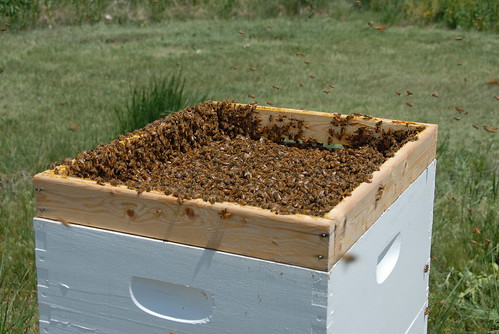
Later we opened the new hive (Hive #2 below). This was where we had just installed the swarm the day before. Guess what? Nobody was home! Where had they gone?

We sure don't have this beekeeping stuff figured out. If anyone has an explanation, please post a comment.
Saturday, May 19, 2007
Swarm Capture: May 19, 2007
We were scheduled to get our second package of bees yesterday, but no joy. The supplier called and said they had some weather delays and it didn't ship as promised. They proposed next week. This is the third delay and we're almost to the end of May.
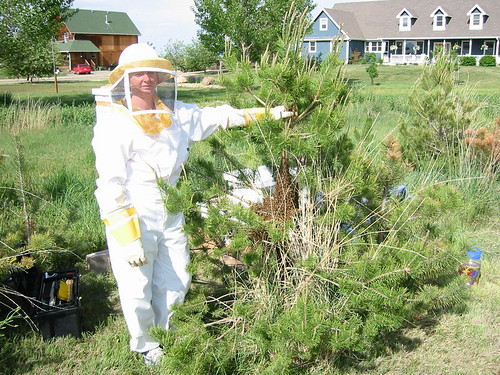
I was out getting things ready in the bee yard this afternoon and setting up the new hive-box, when I looked over and saw a huge swarm resting on a nearby pine tree. Now we don't know for sure if this swarm is a split from our hive or someone else's, but it was a big one. We changed our afternoon plans and went right to the books to see what we needed to capture it.
Anyway, here's a video showing our exciting afternoon capturing the swarm.
EDIT: Below is a snap-shot of the swarm on the pine-tree... It was a very nice young tree that was going to grow up and shade our hives, but we had to sacrifice it to capture the swarm.
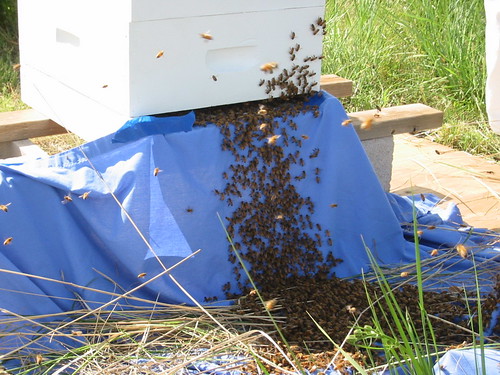
The picture below shows the swarm marching into the new hive. This was fascinating to watch. You can see a bit of it in the video.

I was out getting things ready in the bee yard this afternoon and setting up the new hive-box, when I looked over and saw a huge swarm resting on a nearby pine tree. Now we don't know for sure if this swarm is a split from our hive or someone else's, but it was a big one. We changed our afternoon plans and went right to the books to see what we needed to capture it.
Anyway, here's a video showing our exciting afternoon capturing the swarm.
EDIT: Below is a snap-shot of the swarm on the pine-tree... It was a very nice young tree that was going to grow up and shade our hives, but we had to sacrifice it to capture the swarm.
The picture below shows the swarm marching into the new hive. This was fascinating to watch. You can see a bit of it in the video.
Sunday, May 13, 2007
Tuesday, May 01, 2007
May Day 2007
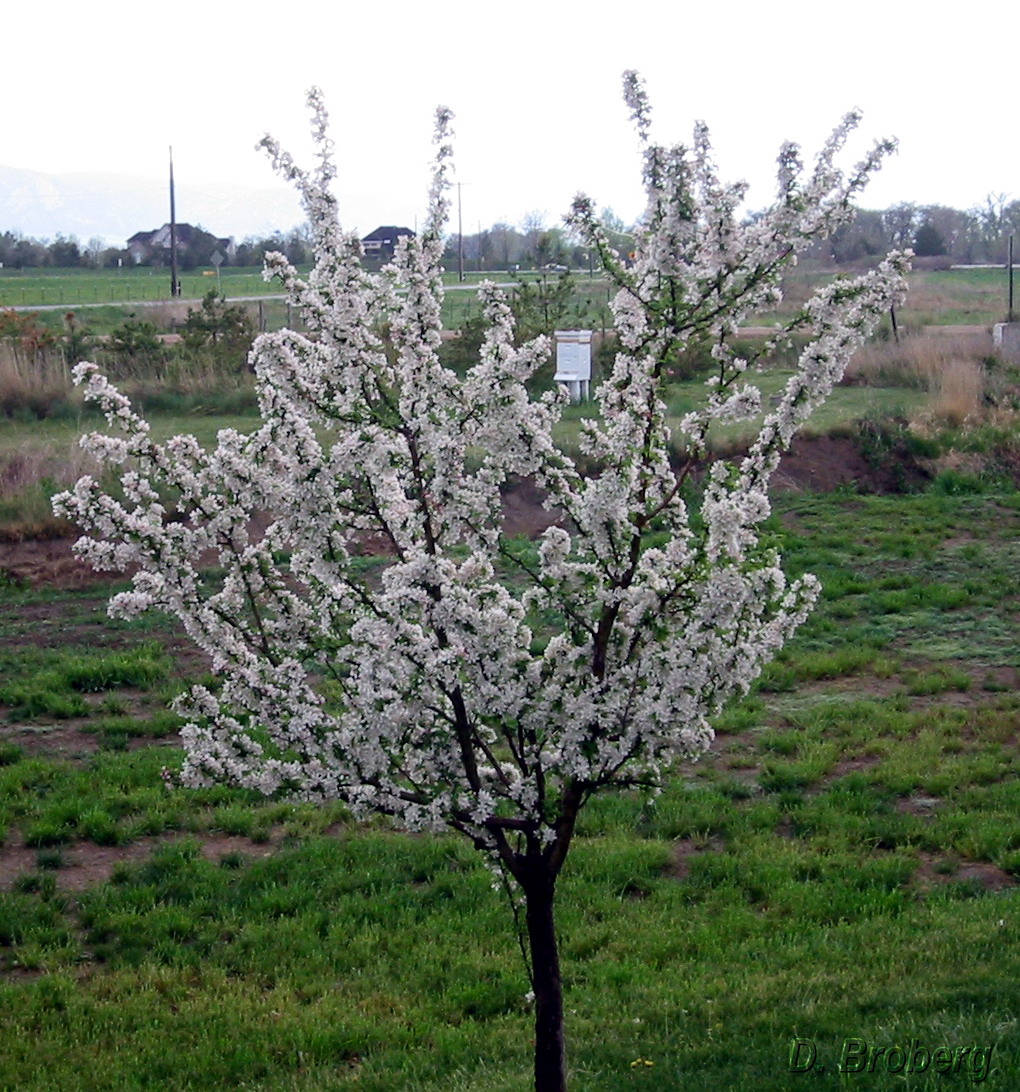
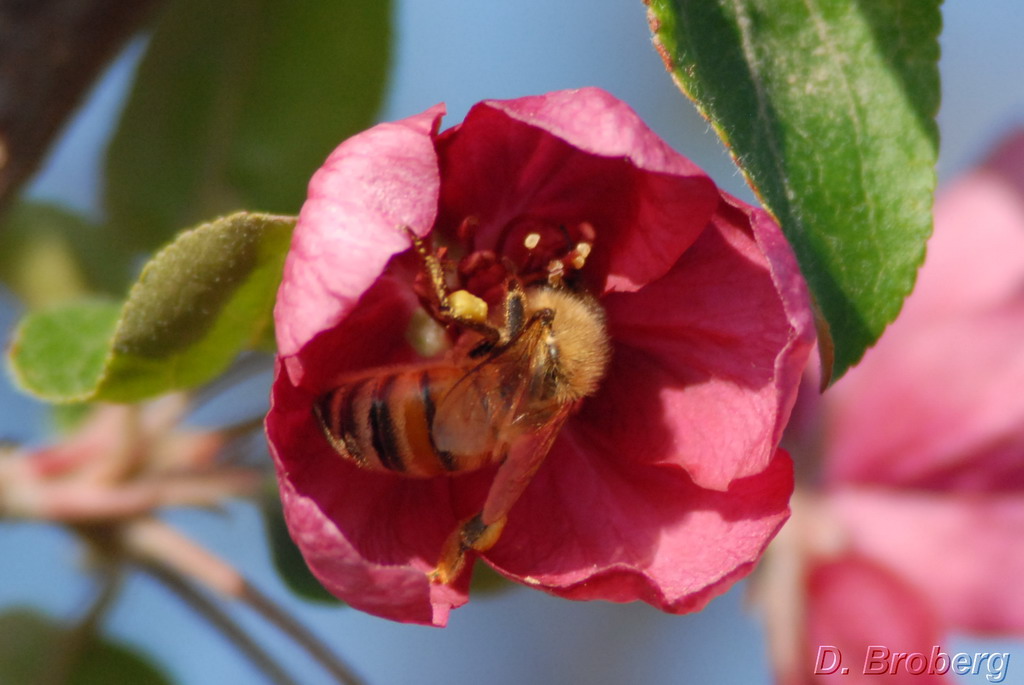
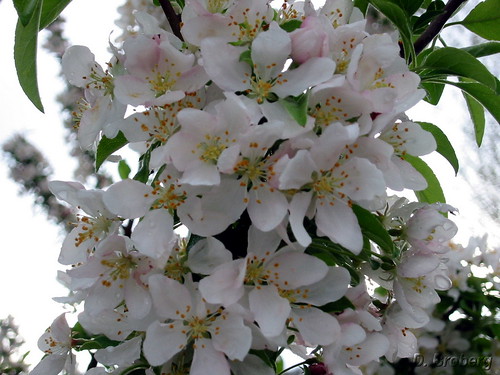
Happy May Day! Spring at our place is in full bloom. Virtually every one of our fruit trees are blooming at the same time now. We've got three varieties of crabapple trees, Granny Smith and Gala apples, cherries, plum and the choke-cherries lining the drive are all blooming this week. There are also a few flowering shrubs blooming and even the lilacs have started to bloom just this morning. I suspect the bees think they're in heaven right about now.
We've had a wet April and everything is so green too. It's quite a switch from last year. Yesterday (April 30) also marked our first harvest from the garden: 4 lbs of fresh rhubarb.
We've got about two more weeks before the new bees arrive.
Tuesday, April 24, 2007
The Drones! (April 22nd Inspection)
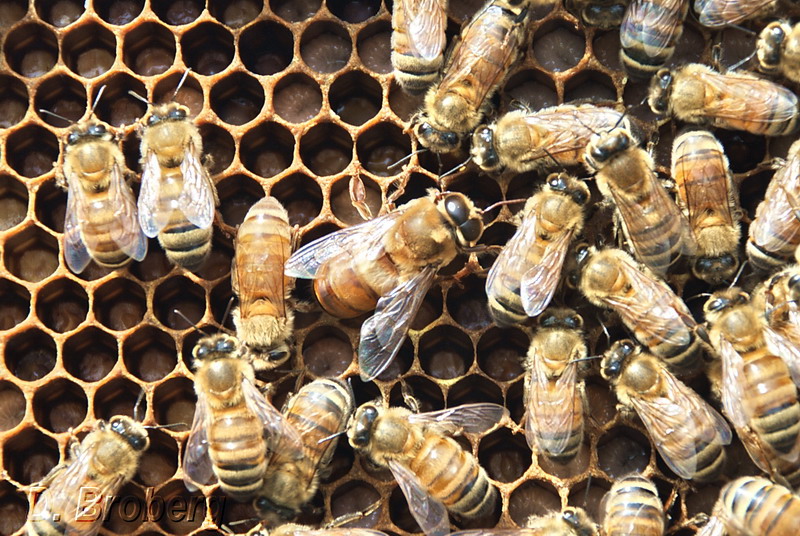
We've been continuing to provide syrup for the bees, at about a gallon a week. They seem to be gathering plenty of pollen, so we are not providing any pollen patties.
During this most recent inspection we saw plenty of drones (as shown in the picture above). There also seemed to be plenty of brood, so we did not completely open the hive looking for the queen.
EDIT: The picture below shows some more of the (now empty) burr comb on the top of the frames. Was it drones?
The most unusual thing, was the extended comb on the bottoms of the frames. Now that the top burr comb was empty, the bottom was occupied by larvae. In this picture (below) notice we accidentally broke open some of this capped brood and can see the nearly formed bee (is it a new queen?). Can you see the eyes?

In the yard, there is an abundance of dandelions this year, perhaps from the wetter spring we've had. The bees can be seen frequenting the dandelions and the pear blossoms. Soon our crab apples will be opening, followed by the choke-cherries and lilacs.
EDIT: Here is a visitor on the dandelions:

Monday, March 26, 2007
Pollen & The Queen (Mar 25th Inspection)
Spring is in the air as well as the bees. What a great time of year especially after the long, snowy winter that has lingered over Colorado this year. As you can see by my husband's great photos, we have been to the hive several times. The first time was to see how much food the bees had consumed and whether we needed to fatten them up, so to speak. The other couple of times we were in search of the queen. This is not always as easy as it sounds since she doesn't sit on a throne or wear a crown but she is bigger and always surrounded by her loyal subjects and in our case, she has a big white dot in her back. I guess we were looking in the wrong area the other times because she remained elusive, but this time she was there, in all her glory. After the tiny, trumpet fanfare we moved on to check out the nursery. Lots of tiny bees will soon be emerging. So despite our fears of this mysterious disappearing bee syndrome and our general lack of beekeeping experience, it seems our bees will emerge to pollinate and make us some more of that wonderful honey!
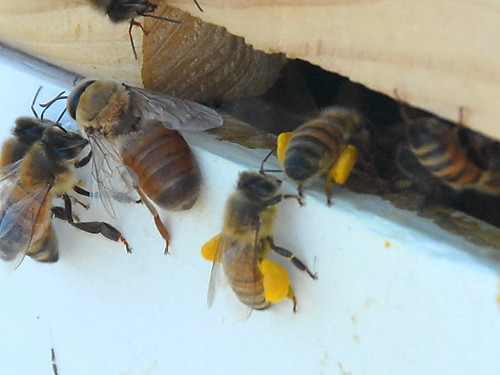 Worker bees bringing home the pollen
 Her Royal Majesty the Queen
Monday, March 05, 2007
March 4th & 11th Inspections
March 4th: Good news: The hive looked very strong today! However, it looked like most of their honey stores were gone, so we began the spring feeding.


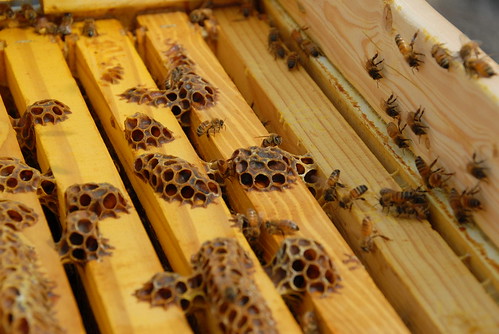
EDIT: We also noticed some comb building at the bottom of the frames... Not sure if that is normal or an indication of a pending swarm?
We inspected again on March 11th:
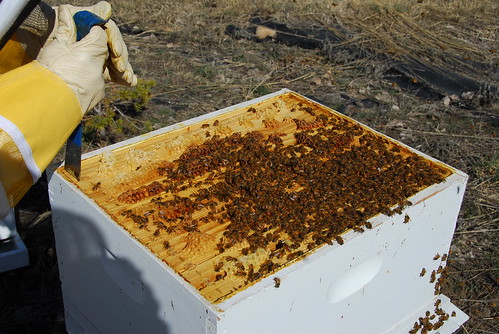
 This time, there was quite a bit of comb up top too. The shot below shows more of this comb on the top. It looks like some had larvae.
We also cleaned out the bottom board. Here is what the gunk collected over the winter looked like.
EDIT: We also noticed some comb building at the bottom of the frames... Not sure if that is normal or an indication of a pending swarm?
We inspected again on March 11th:
 This time, there was quite a bit of comb up top too. The shot below shows more of this comb on the top. It looks like some had larvae.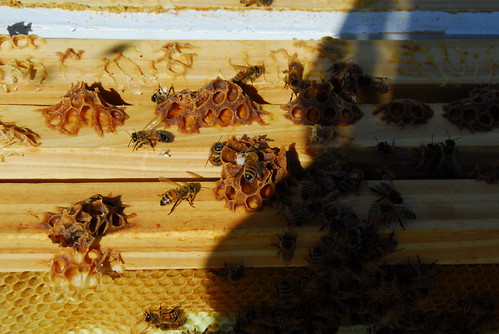
We also cleaned out the bottom board. Here is what the gunk collected over the winter looked like.

Subscribe to:
Posts (Atom)


 Posts
Posts

